When Traits Overlap:
For many families in our community, the journey toward understanding their child’s needs is anything but straightforward. CYP rarely present in neat diagnostic boxes, and when traits from OCD, ADHD, and Autism overlap, the picture becomes even more complex. This overlap can lead to misinterpretation, delayed identification, and support plans that don’t quite fit what the child actually needs.
This article explores why these presentations can be confusing, how overlapping traits can mask or mimic one another, and why rumination especially in CYP can significantly disrupt sleep and emotional regulation.
Why Overlapping Traits Matter
Professionals often look for “classic” presentations: ADHD as distractible and impulsive, Autism as routine‑focused and socially different, OCD as ritualistic and anxious. But CYP rarely follow these textbook patterns.
When traits overlap, they can:
- Amplify each other (e.g., ADHD impulsivity + OCD rumination)
- Mask each other (e.g., Autism rigidity mistaken for OCD compulsions)
- Confuse the diagnostic picture (e.g., ADHD in girls overshadowed by autistic masking)
- Lead to partial or incorrect labels (e.g., “just ADHD” when sensory needs and social differences are present)
This is why so many parents are told one thing early on, only to discover later that their child’s profile spans multiple neurodevelopmental conditions.
How ADHD Traits Can Be Mistaken for Autism and Vice Versa
A child who struggles with attention, emotional regulation, and executive functioning may initially appear to have ADHD alone. But when you look more closely, you might also see:
- sensory sensitivities
- difficulty with social nuance
- a strong need for predictability
- intense, focused interests
These are autistic traits but they can be overshadowed by the more visible ADHD behaviours.
Similarly, autistic CYP who mask socially or who present as “quiet, anxious, and perfectionistic” may be misread as having OCD or anxiety alone.
The overlap doesn’t mean the traits cancel each other out. It means the child is navigating multiple layers of cognitive, sensory, and emotional demand simultaneously.
Rumination: The Hidden Barrier to Sleep
One of the most overlooked challenges in CYP with overlapping profiles is rumination the mental “looping” of thoughts that won’t switch off.
Rumination can look like:
- replaying conversations
- worrying about mistakes
- mentally rehearsing tomorrow’s events
- intrusive thoughts that feel impossible to ignore
- getting stuck on “what if” scenarios
- sensory memories that feel too intense to let go
For CYP with ADHD, Autism, OCD or any combination, rumination can be driven by:
- OCD: intrusive thoughts + compulsive mental checking
- ADHD: hyperfocus + difficulty shifting attention
- Autism: cognitive looping + need for closure or predictability
At bedtime, when the world goes quiet, these loops get louder. The brain is meant to down‑regulate, but instead it ramps up – analysing, replaying, predicting, worrying.
This is why so many CYP:
- take hours to fall asleep
- wake frequently
- experience night‑time anxiety
- struggle with morning fatigue
- appear “wired but tired”
It’s not poor routine or lack of discipline. It’s neurobiology.
Why Understanding the Overlap Helps Families Advocate
When parents understand the interplay between OCD, ADHD, and Autism, they can advocate more effectively for:
- accurate assessment
- appropriate support plans
- sensory‑informed strategies
- sleep‑support interventions
- school adjustments that actually match need
- recognition that behaviour is communication, not defiance
It also helps families feel less alone. Many parents tell us:
“I always felt like something didn’t add up – now it finally makes sense.”
Understanding the overlap doesn’t just clarify the child’s needs; it validates the parent’s experience.
CYP with overlapping OCD, ADHD, and Autism traits are not “more difficult” they are navigating a world that wasn’t designed with their brains in mind. Their challenges are real, but so are their strengths: creativity, deep thinking, passion, empathy, and resilience.
By recognising the complexity of their profiles, we can move away from narrow labels and toward holistic, compassionate, and informed support.
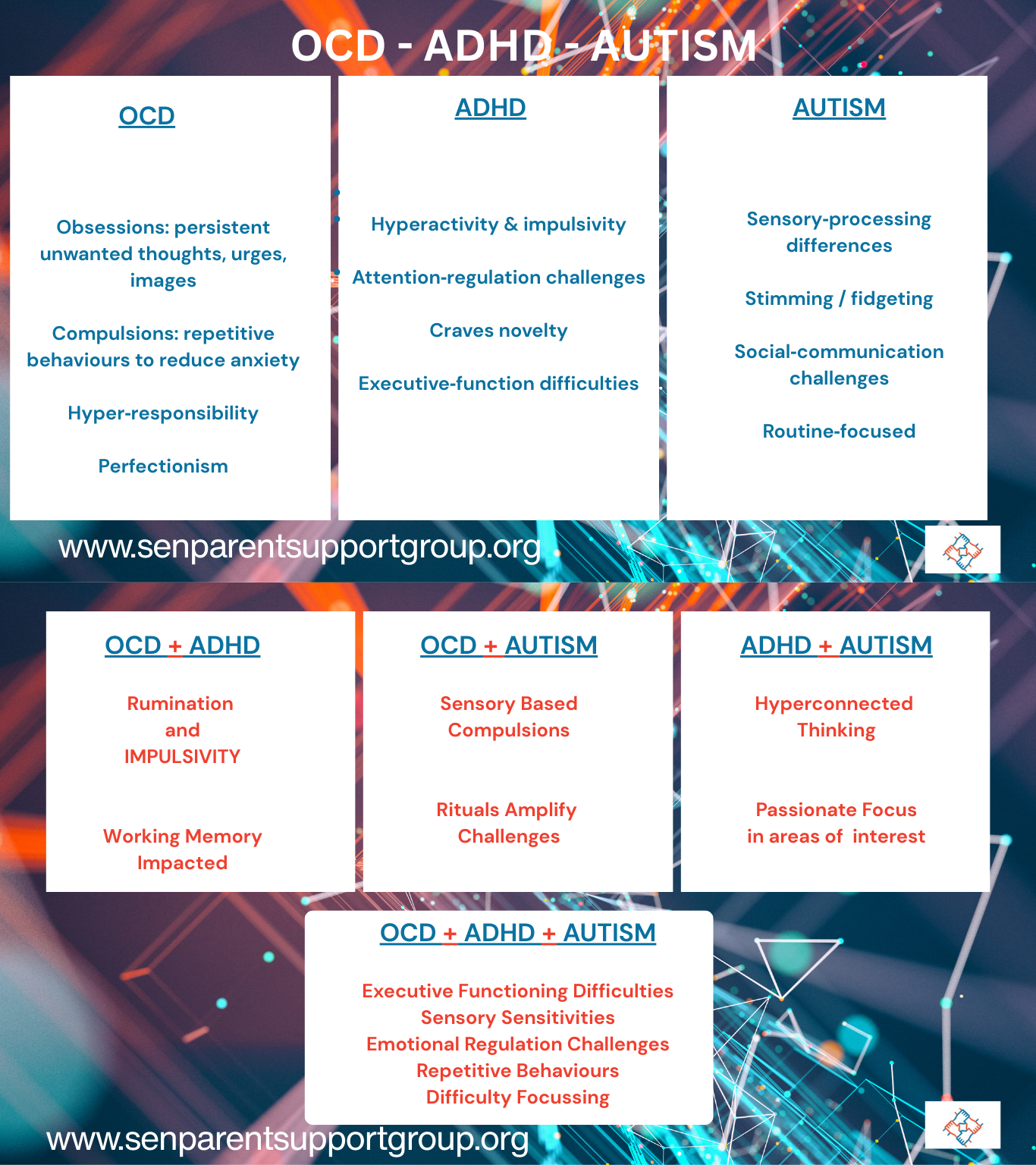
To download this visual Click here:
To read more Blogs click here
Join parents experiencing unacknowledged SEND in schools and be empowered to advocate more efficiently and gain the adjustments needed to support your CYP in their educational journey. Click Here


To benefit from our resource-hub please view below:

All Things EHCP
- Annual Review During Your Appeal?
- LETTER: To LA When They Fail to Give extra 15 Days After Their Amendments
- LETTER: To LA When They Use Specialist Advisory Service (SAS) INSTEAD of Educational Psychologist During EHCPNA Process
- LETTER: LA Failure To Notify If Issuing the plan
- RESOURCE: Moving Local Authorities
Attendance, Exclusions & Sanctions
Complaints
- LETTER: Formal Complaint for RTC Pause
- LETTER – Enforcing Interim Education S43 with LA + Escalation Letter + Tribunal Request
- LETTER: To School When Whole School Approach To Adjustments Is Not Applied Consistently (IEP or EHCP)
- RESOURCE: LGO Outcomes
- LETTER: Right to Choose Rejection 3 Step Complaints Letters