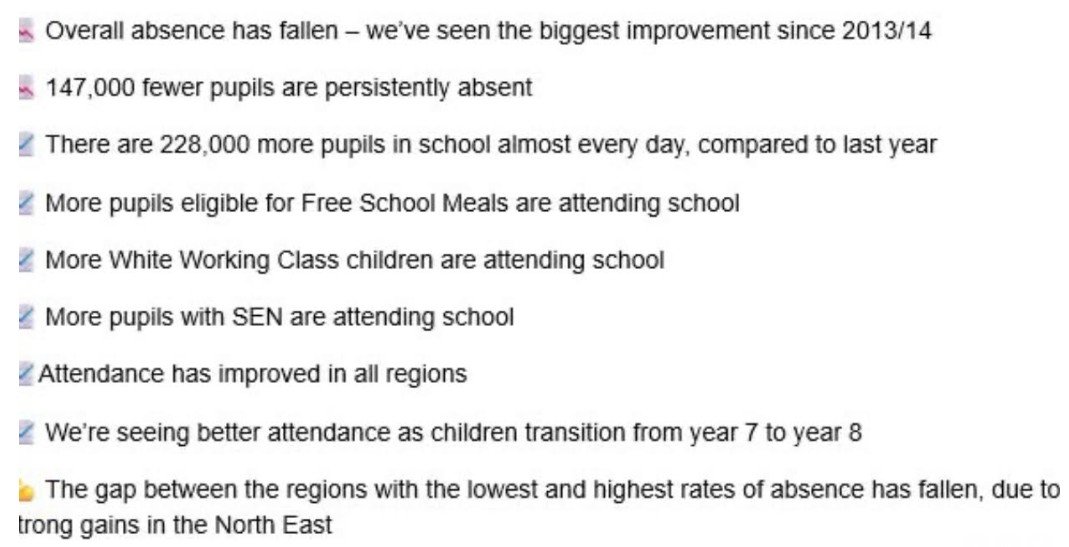
When the Education Secretary posted “this is what progress looks like” and then turned off comments, she highlighted only the most flattering parts of the new DfE attendance statistics. The full dataset tells a more complicated story especially for children with SEND, who sit at the heart of the government’s “inclusion for everyone” reforms.
It’s true that overall absence has fallen. The official figures show a drop from 6.93% to 6.63% across the autumn and spring terms. This is the improvement she is celebrating. Explore education statistics But this is only one part of the picture, and it is not the measure that reflects the lived reality of families whose children are struggling to attend because their needs aren’t being met.
She also claims that 147,000 fewer pupils are persistently absent. The data does show a fall in persistent absence from 19.23% to 17.63%. Explore education statistics But persistent absence is a broad category – it includes everything from mild illness to unmet SEND needs. It does not tell us whether the children in deepest crisis are doing better.
The government’s own statistics show that the group most relevant to SEND reform – pupils who are severely absent, missing at least half of school – has actually grown. Severe absence rose from 2.14% to 2.26%. Explore education statistics This is the group overwhelmingly made up of children with SEND, children waiting for assessments, children on part‑time timetables, and children experiencing emotionally based school avoidance. These are the pupils the reforms claim to help, and their situation is getting worse, not better.
She also states that “228,000 more pupils are in school almost every day.” This figure comes from the DfE’s own framing of the overall improvement. It is mathematically consistent with the fall in overall absence, but again, it does not reflect the children who are missing the most education – the very children the SEND system is supposed to support.
Her claim that “more pupils with SEN are attending school” is technically true only in the sense that overall absence has fallen across all groups. But the same dataset shows that severe absence among SEND pupils, especially those with EHCPs has actually RISEN risen. The number of severely absent pupils with SEND increased by around 5,100 compared to the previous year. So while some SEND pupils may be attending slightly more often, the children in the deepest difficulty are tragically falling further behind.
She also says that attendance has improved in all regions. This is correct for persistent absence, which has fallen everywhere. But again, this does not apply to severe absence, which continues to rise nationally.
The pattern is clear: the government is highlighting the metrics that look good and avoiding the ones that expose the system’s ongoing failures. Severe absence, the most meaningful indicator of whether children with SEND are being supported is rising. The children most affected by unmet need are not benefiting from the improvements being claimed.
Parents deserve the full picture, not selective statistics. Progress for some children does not erase the worsening crisis for those who are most vulnerable. Turning off comments does not change the data. And it certainly does not silence the families living this reality every day.
If you want to know more about the SEND communities take on the White Paper click here!
If you want to understand how best to respond to the White Paper as a SEND Parent click here!


Communicating With School
- LETTER: To School When They Enforce a Part Time Timetable Without Acknowledging Need
- LETTER: To School For Referral To OT/SALT/EP as Part of APDR Cycle
- RESOURCE: Eating Disorders and School Adjustments
- LETTER: Failure To Make Reasonable Adjustments Discrimination
- LETTER: Requesting Reasonable Adjustments
All Things EHCP
- Annual Review During Your Appeal?
- LETTER: To LA When They Fail to Give extra 15 Days After Their Amendments
- LETTER: To LA When They Use Specialist Advisory Service (SAS) INSTEAD of Educational Psychologist During EHCPNA Process
- LETTER: LA Failure To Notify If Issuing the plan
- RESOURCE: Moving Local Authorities
Attendance, Exclusions & Sanctions
Complaints
- LETTER: Formal Complaint for RTC Pause
- LETTER – Enforcing Interim Education S43 with LA + Escalation Letter + Tribunal Request
- LETTER: To School When Whole School Approach To Adjustments Is Not Applied Consistently (IEP or EHCP)
- RESOURCE: LGO Outcomes
- LETTER: Right to Choose Rejection 3 Step Complaints Letters