What Parents Need to Know About the New 2026 Exclusion Guidance
The Department for Education has released a new version of the statutory exclusion guidance, coming into force on 26 July 2026. This update matters for every parent of a child with SEND, because it changes what schools must consider before suspending or permanently excluding a pupil.
You will also be pleased to hear that it also strengthens the expectations around reasonable adjustments, safeguarding, and early intervention.
Sadly, for many families, exclusions don’t happen in isolation. They happen after months – sometimes years – of unmet need, unaddressed behaviour (presentation) communication, and a lack of lawful support. This new guidance is designed to close some of those gaps, and to make sure schools cannot move straight to exclusion without showing the steps they took first.
Here’s what parents need to know.
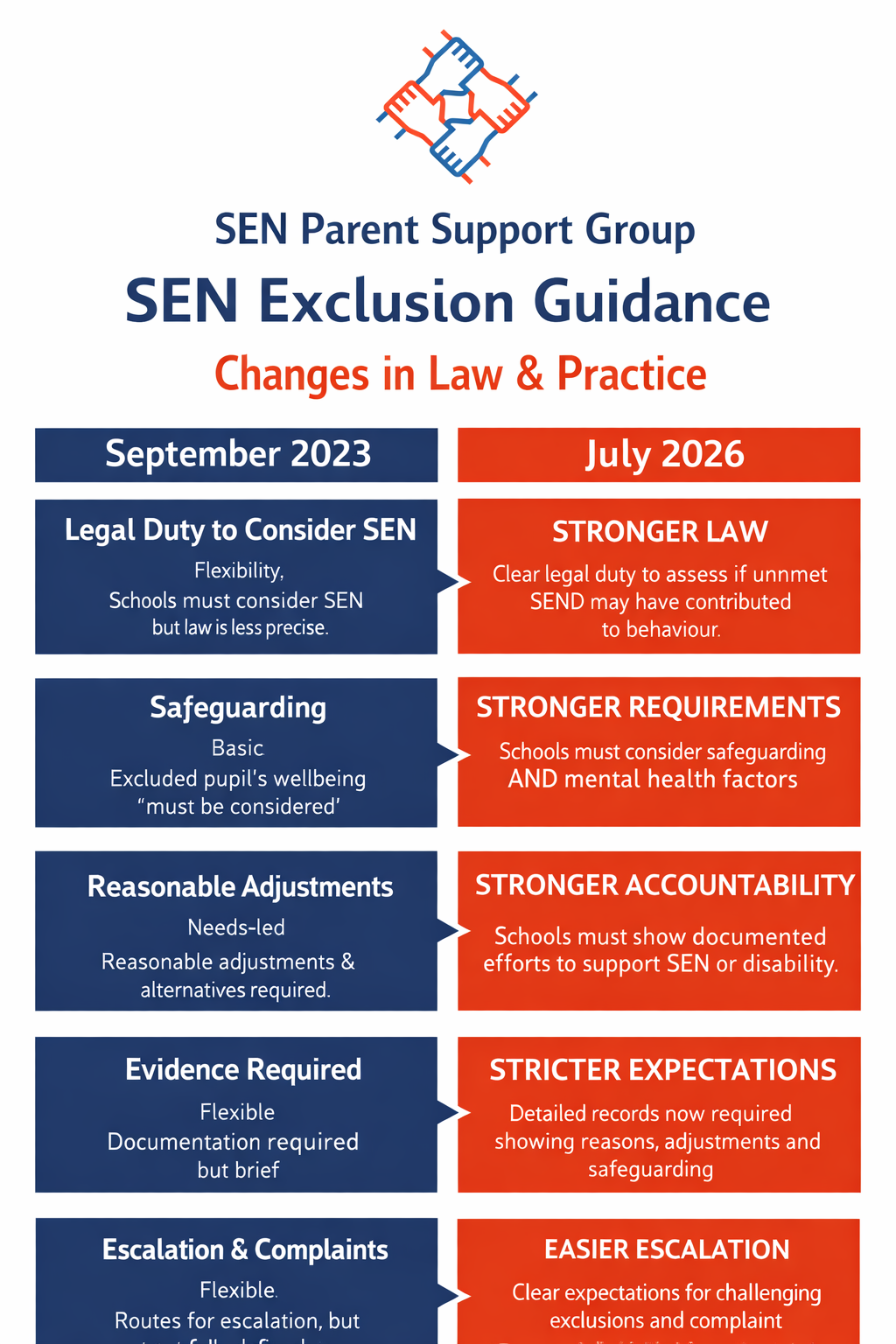
1. Schools must now evidence early intervention and SEND support before exclusion The updated guidance places a stronger legal expectation on schools to show what they did to understand the child’s needs. This includes reasonable adjustments, pastoral support, alternative strategies, and whether unmet SEND contributed to the behaviour. Schools cannot simply say “we tried everything” they must show it.
2. Safeguarding and mental health must be considered The new guidance requires schools to demonstrate that they have considered safeguarding risks, mental health needs, and whether the behaviour was a sign of distress. This is particularly important for autistic pupils, PDA profiles, ADHD, trauma‑affected children, and those with unmet sensory needs.
3. Documentation and decision‑making must be clearer Schools must now keep more detailed records of the reasons for exclusion, the interventions attempted, and the evidence used. This creates a clearer paper trail for parents who need to challenge decisions or escalate concerns.
4. Only suspensions have a time limit The updated guidance clarifies that only suspensions have a maximum duration. Governing boards are not required to meet parents for suspensions, but they must still review the decision and ensure it was lawful.
5. Exclusions must be fair, proportionate, and lawful The guidance reinforces that exclusion should always be a last resort. Schools must consider whether the behaviour was a direct result of unmet need, disability discrimination, or a failure to make reasonable adjustments. If so, exclusion may be unlawful.
What this means for SEND families For many parents, this update gives stronger footing when challenging unfair exclusions. It also increases accountability for schools that have historically used exclusion as a behaviour management tool instead of addressing underlying needs.
If your child is at risk of exclusion, or has already been excluded, you are entitled to ask for the evidence behind the decision. You can request the behaviour logs, intervention records, risk assessments, reasonable adjustment plans, and any SEND‑related documentation used to justify the exclusion.
The new guidance makes it harder for schools to exclude without a clear, lawful process and easier for parents to challenge decisions that don’t meet the statutory standard.
The Working Together to Improve School Attendance (August 2024) guidance and the Exclusion Guidance (July 2026) now operate almost like two halves of the same statutory framework. They’re designed to close the loopholes that allowed schools to treat attendance and exclusion as separate issues.
Here’s how they connect in practice:
1. Shared statutory duties under the Equality Act 2010 and Children and Families Act 2014 Both documents require schools and local authorities to consider disability‑related barriers before taking punitive action. The attendance guidance explicitly says that absence linked to SEND or mental health must be managed through support and reasonable adjustment, not enforcement. The exclusion guidance then reinforces that if those adjustments weren’t made, exclusion may be unlawful.
2. Escalation and accountability The 2024 attendance guidance introduced a duty for schools to have a named senior leader responsible for attendance strategy and to record every intervention. The 2026 exclusion guidance builds on that those same records now form part of the evidence schools must provide when justifying an exclusion. So, if a school hasn’t followed the attendance framework, it cannot lawfully exclude.
3. Early intervention and multi‑agency working Both frameworks emphasise early help and multi‑agency collaboration. Attendance guidance requires schools to identify unmet need and involve SEND teams early; exclusion guidance demands proof that this happened before exclusion. Together, they create a continuous accountability trail from first concern to final decision.
4. Parent involvement and transparency The attendance guidance strengthened parents’ rights to be involved in planning support. The exclusion guidance mirrors that by requiring schools to show how parents were engaged before exclusion. This means your advocacy letters can now cite both documents side‑by‑side to demonstrate procedural failure.
5. Policy alignment for tribunals and complaints Tribunal panels and the LGSCO will now expect schools and LAs to show compliance with both sets of guidance. Failure to follow the attendance framework before exclusion is strong evidence of discrimination or maladministration. 🙌🏼
Further resources you may find beneficial:
GUIDANCE: Exclusions Fixed Term or Permanent – SEN Parent Support Group
VLOG: Sanctions / Isolation / Detention / Exclusions – SEN Parent Support Group
SEN Letter: Addressing Sanctions & Inconsistent Support ©
LETTER: Requesting Reasonable Adjustments – SEN Parent Support Group
Letter: Absence Authorisation & SEN Support© Plus many more…. over 450 in-fact. Register here: Membership Pricing – SEN Parent Support Group (no min subscription)
If you need help understanding your rights or preparing a response to school, our group, our closed group and our other platforms are here to support you. Join over 25k other SEND Parents on this journey – you are not alone!


For more blogs check out the above categories and to view what our resource hub within our membership subscription has to offer view the grid below.

Understanding SEND
- EOTAS & AP: The real legal tests and current to SEND reform comparison
- LETTER: Post 16 SECTION 19 – Formal Letter to LA or Stage 1 Complaint
- GUIDANCE: SEND Need Descriptors For IEP via APDR
- QUICK GUIDE: Example SEND Graduated Response (How APDR is approached In Schools)
- RESOURCE: Executive Functioning
Communicating With School
- LETTER 4: To School following receipt of Formal Attendance Letter
- LETTER 3: To School Based on 3rd Attendance Letter Received
- LETTER 2: ATTENDANCE RESPONDING TO (BELOW 90% ATTENDANCE LETTER)
- LETTER 1: Responding to EARLY AWARENESS Letter from School (before 90% absence)
- LETTER: To School Requesting Reasonable Adjustment for Mobile Phone
Attendance, Exclusions & Sanctions
- Welsh Exclusions: What Happens, What You Can Ask For, and What Schools Must Do
- LETTER 1: Responding to EARLY AWARENESS Letter from School (before 90% absence)
- LETTER: Responding To Prosecution s444
- GUIDANCE: Exclusions Fixed Term or Permanent
- LETTER: To School When They Fail To Progress After Part Time Time-Table
Complaints
- LETTER: To LA – SEND Accountability Under S23 Children Act 2004
- LETTER: To LA When They Refuse to Reassess
- LETTER: Stage 1 LA on Grounds of Maladministration During EHCP NA Process
- LETTER: Post 16 SECTION 19 – Formal Letter to LA or Stage 1 Complaint
- LETTER: To School Requesting Reasonable Adjustment for Mobile Phone