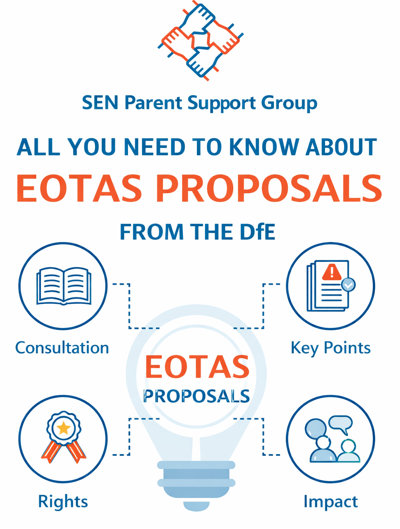
The Key Changes the DfE Is Proposing, and Why Parents Must Respond
Following the post I shared in our closed group, I’ve now had time to review the Department for Education’s proposals and the full consultation questions. What is emerging is not a minor tweak to EOTAS. It is a fundamental reshaping of how EOTAS will operate within the reformed SEND system.
Every day I speak with parents who are holding their children together with sheer determination, creativity, and love parents who have fought for EOTAS not because it was convenient, but because it was the only way their child could learn safely, meaningfully, and without harm.
Reading the DfE proposals, I felt that familiar tightening in my chest the fear that something fragile, hard won, and life saving could be reshaped by people who have never lived it. These reforms reach directly into the homes of families who have already been through too much. They touch children who cannot survive in school environments, children whose progress only began once the pressure to “fit” was removed.
That is why this guidance matters. That is why your voice matters. We are going to walk through every consultation question together clearly, calmly, and with purpose so that parents can respond with confidence and ensure that the future of EOTAS is shaped by those who understand it best: the families who rely on it but before we do lets break down what the proposals mean.
This consultation is our opportunity to protect the future of EOTAS and ensure it remains a lawful, needs‑based provision not something gatekept by schools or restricted by national policy.
Below is a clear breakdown of the key changes the DfE is proposing, what they mean for families, and where parent rights may be diminished.
1. EOTAS will no longer be a standalone arrangement
Under the proposals, every child receiving EOTAS would be placed on roll at a named school or FE college, which would then be responsible for managing the EOTAS package. This is a major structural shift.
Right now, EOTAS is a direct Local Authority responsibility written into Section F of the EHCP. Under the new model, a school becomes the accountable body even if the child cannot attend that school.
The DfE suggests this would “generally be a specialist setting,” not the school where the child previously experienced trauma or placement breakdown.
This raises immediate concerns about:
- school‑led reintegration pressure
- institutional decision‑making
- reduced parental influence over provision
2. EOTAS will be subject to national standards and oversight
The DfE is consulting on whether EOTAS providers should have to meet national quality standards, and whether LAs should have a stronger role in checking compliance. This moves EOTAS away from the flexible, bespoke arrangements many families rely on.
It risks:
- narrowing the pool of tutors and therapists
- excluding niche or specialist providers
- reducing parent‑chosen provision
3. LAs will be held accountable for “only using EOTAS when it is in the best interest of the child”
The consultation states that LAs should be challenged if they use EOTAS because they “cannot find a school place.” This signals a tightening of criteria and a potential narrowing of eligibility.
It reframes EOTAS as:
- exceptional
- temporary
- something to be justified
- something to be monitored
This is a cultural shift away from the current legal position, where EOTAS is a lawful, equal alternative to school.
4. Children currently receiving EOTAS (secondary age and above) can continue but with conditions
The DfE says secondary age pupils currently receiving EOTAS will be allowed to continue under the new system.
However:
- their packages may be reviewed
- provision may be reshaped
- families may be encouraged toward Specialist Provision Packages
- bespoke arrangements may be replaced with standardised ones
The DfE is openly asking how current EOTAS arrangements should be “transitioned” into the reformed model. That alone should set alarm bells ringing.
5. Primary age children currently receiving EOTAS may face reassessment
This is one of the most concerning proposals. The DfE suggests:
- mandatory reassessment at the end of primary
- possible removal of EOTAS
- possible transition back to school
- continuation of EOTAS only if wrapped inside a “specialist provision package”
This is a direct erosion of stability for younger children.
6. EOTAS could become part of a “Specialist Provision Package”
This aligns EOTAS with the wider SEND reforms, which propose replacing specialist placements with flexible “packages” delivered across multiple providers. This risks:
- diluting Section F
- reducing clarity
- reducing enforceability
- increasing LA discretion
Parents could lose the ability to secure bespoke, legally specific provision.
7. Online learning will be tightly controlled
The DfE wants:
- accreditation
- LA oversight
- limits on online provision
- possible restrictions on parent‑chosen providers
This could significantly reduce flexibility for families who rely on online tutors or specialist remote provision.
8. Health‑related Alternative Provision will be reshaped
The DfE is examining:
- reintegration expectations
- medical evidence requirements
- LA control over AP pathways
This risks narrowing access for children with mental health‑related needs and pushing families toward school or Specialist Provision Packages.
What This Means for Parents Who Currently Have EOTAS
If your child is secondary age (11+)
- Your current EOTAS package can continue.
- You cannot be forced back into school.
- You may be pressured to consider transition, but it is voluntary.
- You will be attached to a named school, which will manage the EOTAS package.
If your child is primary age this is where the biggest risk lies.
The DfE proposes:
- mandatory reassessment
- possible removal of EOTAS
- possible transition back to school
- EOTAS only continuing if wrapped inside a “specialist provision package”
This is a major erosion of stability for primary families.
Where Parent Rights May Be Diminished
1. EOTAS becomes school managed, not parent led
This risks:
- reduced parental control
- increased reintegration pressure
- decisions made by a school that has never met the child
2. LAs will be judged for “over using” EOTAS
This creates a perverse incentive for LAs to push children back into school.
3. Primary EOTAS becomes unstable
Mandatory reassessment threatens long term arrangements.
4. EOTAS becomes part of a “specialist provision package”
This dilutes Section F and increases LA discretion.
5. National standards may restrict bespoke provision
Many EOTAS packages rely on niche tutors and flexible arrangements that may not meet new criteria.
6. Increased LA oversight = increased LA power
This risks more refusals and more gatekeeping.
7. “Transition arrangements” overseen by AP schools
AP schools are not neutral they have reintegration targets.
Bottom Line: What This Means for Families?
EOTAS is being reframed as:
- temporary
- exceptional
- school managed
- LA controlled
- reintegration focused
- harder to obtain
This is a major shift away from the current legal position, where EOTAS is a lawful, needs based provision written directly into Section F.
Why This Consultation Is Strategically Dangerous
If parents do not respond, the DfE will assume:
- EOTAS should be restricted
- EOTAS should be temporary
- EOTAS should be standardised
- EOTAS should be reintegration‑focused
- EOTAS should be LA‑controlled
- EOTAS should be harder to obtain
They will not hear:
- why EOTAS is essential
- why school is unsafe for some children
- why bespoke packages save lives
- why flexibility is non‑negotiable
- why reintegration is harmful for some
- why parent‑led provision works
This consultation is the only chance parents have to influence the future of EOTAS.
Once it closes, the DfE will move forward with reforms that may:
- dilute EOTAS
- restrict EOTAS
- reshape EOTAS
- remove EOTAS for many children
the consultation closes 18th September 2026. Can you afford NOT to complete the consultation?
Consultation & SEN Parent Support Group’s Q & A are hyperlinked within this. However, here it is again for ease!
SEND REFORM: EOTAS CONSULTATION PARENTAL SUPPORT. – SEN Parent Support Group
Please share to the wider community – we need to ensure that EOTAS remains as is – our children’s safeguarding literally depends on it!


Join our supportive closed peer support group with highly responsive administrators giving free advise here: SEN Parent Support Group™
READ our informative blogs covering all subjects relating to the SEND Educational Processes
or
VIEW our arsenal of parental resources within our Resource Hub to help you navigate every eventuality, below.
We are here to help you
“NAVIGATE THE SEND EDUCATIONAL PROCESSES FOR BETTER OUTCOMES – TOGETHER”™
Don’t just take our word for it, read our 5 STAR Reviews Here

Understanding SEND
- EOTAS & AP: The real legal tests and current to SEND reform comparison
- LETTER: Post 16 SECTION 19 – Formal Letter to LA or Stage 1 Complaint
- GUIDANCE: SEND Need Descriptors For IEP via APDR
- QUICK GUIDE: Example SEND Graduated Response (How APDR is approached In Schools)
- RESOURCE: Executive Functioning
Communicating With School
- LETTER 4: To School following receipt of Formal Attendance Letter
- LETTER 3: To School Based on 3rd Attendance Letter Received
- LETTER 2: ATTENDANCE RESPONDING TO (BELOW 90% ATTENDANCE LETTER)
- LETTER 1: Responding to EARLY AWARENESS Letter from School (before 90% absence)
- LETTER: To School Requesting Reasonable Adjustment for Mobile Phone
Attendance, Exclusions & Sanctions
- Welsh Exclusions: What Happens, What You Can Ask For, and What Schools Must Do
- LETTER 1: Responding to EARLY AWARENESS Letter from School (before 90% absence)
- LETTER: Responding To Prosecution s444
- GUIDANCE: Exclusions Fixed Term or Permanent
- LETTER: To School When They Fail To Progress After Part Time Time-Table
Complaints
- LETTER: To LA – SEND Accountability Under S23 Children Act 2004
- LETTER: To LA When They Refuse to Reassess
- LETTER: Stage 1 LA on Grounds of Maladministration During EHCP NA Process
- LETTER: Post 16 SECTION 19 – Formal Letter to LA or Stage 1 Complaint
- LETTER: To School Requesting Reasonable Adjustment for Mobile Phone