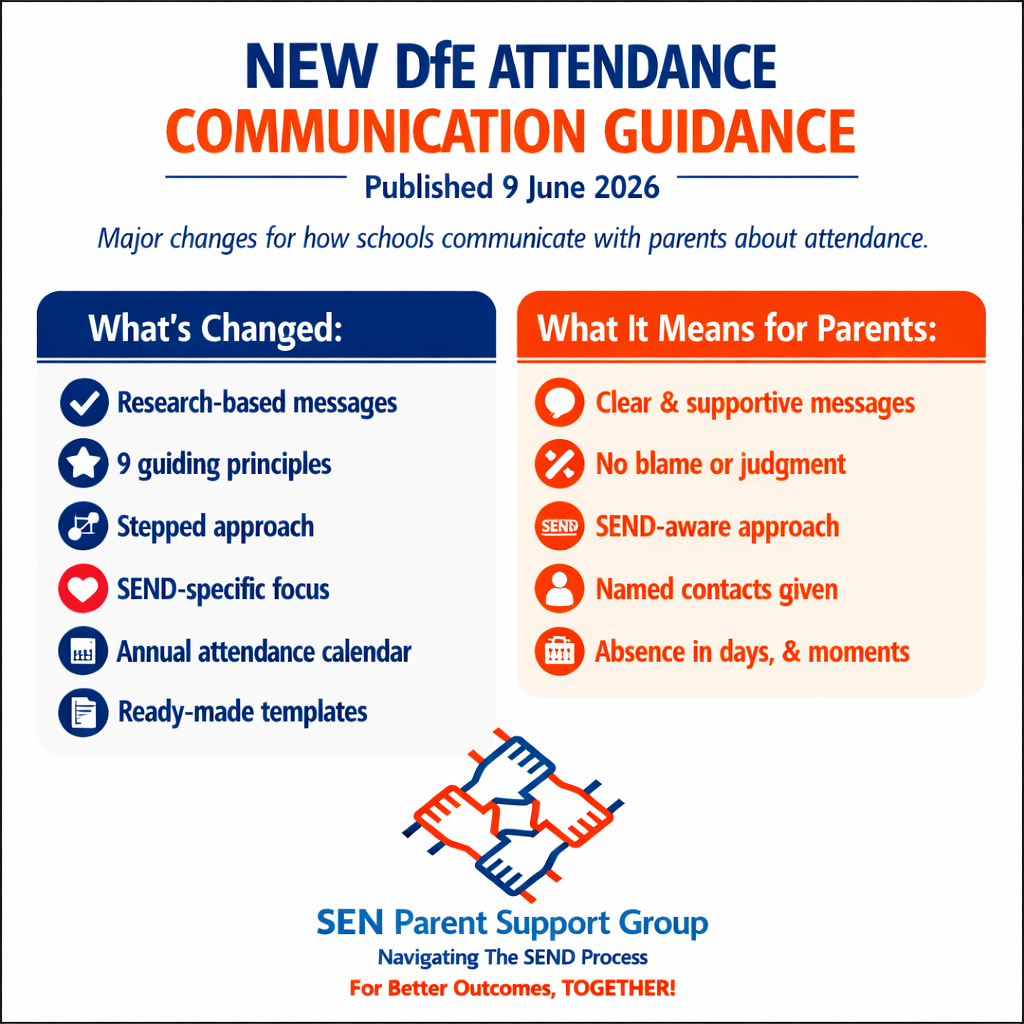
The Department for Education has released a major update to how schools must communicate with parents about attendance. This new guidance replaces the older 2024 version and introduces a completely new, research‑based approach one that focuses on understanding, belonging, and support, not blame.
What’s Changed
Schools must now follow a behavioural‑science‑based communication model designed around empathy and clarity. Here’s what’s new:
1. Research‑based messaging rules Messages must focus on belonging, friendships, and daily experiences rather than statistics or percentages. Parents should hear about what their child is missing – lessons, moments, connections – not just numbers.
2. Nine guiding principles for communication Schools must assume positive intent, tailor tone for SEND, celebrate small steps, and keep messages practical and kind.
3. Stepped communication ladder The DfE now provides a tiered approach for different situations anxiety, illness, SEND, or legal escalation – with clear examples of tone and wording.
4. SEND‑specific communication rules Schools must involve the SENCO in shaping messages and ensure communication is paced and phrased appropriately for each family’s needs.
5. Annual communications calendar Schools must plan attendance messaging across the year, using term‑by‑term “moments” and parent mindset guidance.
6. Ready‑made templates and scripts The guidance includes email and text templates, phone scripts, and short animations for parents – all designed to make communication consistent and supportive.
7. Support‑first, not enforcement The DfE is clear: absence is often a symptom, not a choice. Legal notices must only be used when support has been exhausted and needs are fully understood.
What This Means for Parents
You should now expect communication that feels clear, kind, and personalised. Schools are required to:
- Contact you early, in a supportive tone
- Offer help before mentioning penalties
- Involve the SENCO when needs are identified
- Provide written plans and follow‑up dates
- Explain absence in days and experiences, not percentages
- Give you a named contact, not a generic department
- Keep communication consistent and transparent
If your child’s attendance is affected by SEND, anxiety, or unmet need, schools must adapt their messaging and avoid enforcement until support has been properly offered.
This update is a turning point for families. It recognises that attendance challenges are often rooted in unmet needs, anxiety, or systemic barriers not poor parenting. By shifting the tone from compliance to connection, the DfE aims to rebuild trust between schools and families.
In Summary
The June 2026 guidance means parents should now receive communication that is:
✅ Supportive ✅ SEND‑aware ✅ Transparent ✅ Practical ✅ Focused on belonging and wellbeing
If your school’s messages still feel blaming or inconsistent, you can reference this new guidance and ask for communication that meets the updated standards.
Attendance Communication Flow – What Happens and When
1️⃣ Early Awareness (Before 90%)
School action:
- Monitor patterns and notice early dips.
- Send a supportive check‑in message — not a warning.
- Use positive, belonging‑focused language (“We’ve noticed some missed days — how can we help?”).
Parent receives:
- A friendly email or call.
- Offer of support or adjustments.
- No mention of penalties or attendance targets.
2️⃣ Persistent Absence Trigger (Below 90%)
School action:
- Invite parent to a meeting.
- Explore SEND, health, anxiety, or unmet need.
- Create a written support plan with actions for both school and home.
- Involve SENCO in communication.
Parent receives:
- Meeting invite and written summary.
- Named contact person.
- Clear plan with review date.
3️⃣ Review and Escalation (Ongoing Issues)
School action:
- Review progress.
- Escalate support, not blame.
- Consider Early Help, health referrals, or EHC needs assessment.
- Keep tone calm and factual.
Parent receives:
- Updated plan and evidence of what school has tried.
- Clear explanation of next steps.
- Continued supportive contact.
4️⃣ Formal Attendance Process (If No Improvement)
School action:
- Send formal letter explaining concerns.
- Show evidence of support already offered.
- Invite parent to respond before any enforcement.
Parent receives:
- Formal letter with clear reasoning.
- Opportunity to reply or provide evidence.
- Assurance that SEND and health factors are being considered.
5️⃣ Local Authority Review
LA action:
- Review school’s evidence.
- Check SEND, health, and unmet need.
- Decide if enforcement is appropriate.
Parent receives:
- LA letter explaining findings.
- Option to respond or challenge.
- Confirmation of next steps.
6️⃣ Enforcement (Only if Appropriate)
LA action:
- Issue warning or penalty notice only if absence is not linked to SEND, disability, or unmet need.
- Continue offering support alongside enforcement.
Parent receives:
- Clear explanation of reason for enforcement.
- Information on how to challenge or appeal.
- Assurance that support remains available.
7️⃣ Ongoing Communication
School and LA must:
- Keep messages consistent and supportive.
- Use plain English and avoid jargon.
- Celebrate small improvements.
- Maintain open dialogue with parents.
Each letter issued should meet this directive: Early Concern → Meeting & Support Plan → Review & Escalation → Formal Letter → LA Review → Enforcement (if appropriate) → Ongoing Support
For tailored placeholder SEND Law grounded responses to each stage, click on the hyperlink within each reference point starting with Early Concern.
All Letters to respond to the stages above are hyperlinked. Save for future reference


Join us here within our Facebook Group or book here for 1:1 mentor support
To review our Resource Hub ⬇️
To join our membership which offers in excess of 450 letters and resources, 8 CPD parent training packages in addition to un restricted use of our SEND Bible, SEN Support Tracker, EHCP Draft Checker and our under development SENDIST Guardian for full Tribunal Case management Click here

Understanding SEND
- EOTAS & AP: The real legal tests and current to SEND reform comparison
- LETTER: Post 16 SECTION 19 – Formal Letter to LA or Stage 1 Complaint
- GUIDANCE: SEND Need Descriptors For IEP via APDR
- QUICK GUIDE: Example SEND Graduated Response (How APDR is approached In Schools)
- RESOURCE: Executive Functioning
Communicating With School
- LETTER 4: To School following receipt of Formal Attendance Letter
- LETTER 3: To School Based on 3rd Attendance Letter Received
- LETTER 2: ATTENDANCE RESPONDING TO (BELOW 90% ATTENDANCE LETTER)
- LETTER 1: Responding to EARLY AWARENESS Letter from School (before 90% absence)
- LETTER: To School Requesting Reasonable Adjustment for Mobile Phone
All Things EHCP
Attendance, Exclusions & Sanctions
- Welsh Exclusions: What Happens, What You Can Ask For, and What Schools Must Do
- LETTER 1: Responding to EARLY AWARENESS Letter from School (before 90% absence)
- LETTER: Responding To Prosecution s444
- GUIDANCE: Exclusions Fixed Term or Permanent
- LETTER: To School When They Fail To Progress After Part Time Time-Table
Complaints
- LETTER: To LA When They Refuse to Reassess
- LETTER: Stage 1 LA on Grounds of Maladministration During EHCP NA Process
- LETTER: Post 16 SECTION 19 – Formal Letter to LA or Stage 1 Complaint
- LETTER: To School Requesting Reasonable Adjustment for Mobile Phone
- RESOURCE: How To Write A Structured / Impactful Complaint (LA or School)