By SEN Parent Support Group
Social stories are one of the most widely used tools in SEND practice, yet most parents only encounter them when a transition is already going wrong.
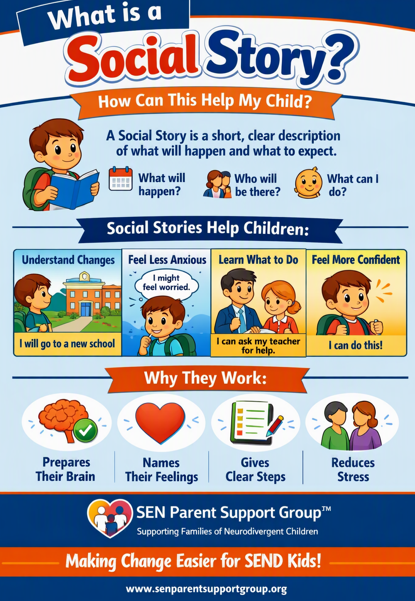
At their core, social stories are short, personalised visual narratives that explain a situation in calm, concrete language. They give a child a preview of what will happen, who will be there, what the expectations are, and what they can do if they feel unsure.
For neurodivergent children, that preview is often the difference between overwhelm and calmness.
Although social stories were originally developed by Carol Gray in the early 1990s for autistic children, their use has expanded significantly. A 2023 UK practitioner survey found that over 78% of specialist settings use social stories as part of their transition planning, and 62% of mainstream schools report using them for pupils with communication or emotional regulation needs.
They’re now relied on by teachers, SENCOs, speech and language therapists, occupational therapists, and family support workers because they reduce anxiety, increase predictability, and help children rehearse new experiences safely.
Transitions are one of the biggest pressure points for neurodivergent children. Moving from one activity to another, entering a new classroom, meeting a new adult, or shifting from home to school can trigger uncertainty, sensory overload, and fight‑flight responses.
Research from the National Autistic Society shows that transitions are a top‑three trigger for distress behaviours, and that structured preparation reduces transition‑related anxiety by up to 40%.
Social stories work because they remove the “unknown”. When a child knows the sequence, the environment, and the plan, their nervous system can settle.
A good social story breaks the moment down step‑by‑step.
It names what the child might see, hear, or feel.
It explains what adults will do. It offers choices and coping strategies.
It reassures the child that they will be safe and supported.
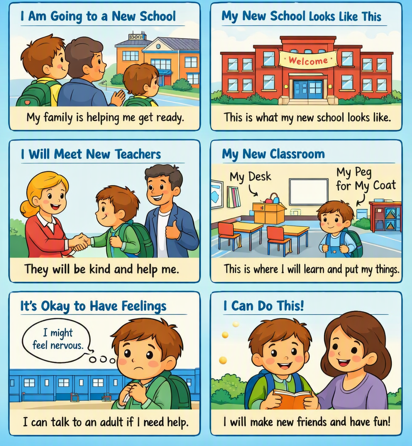
For example, a transition story for moving to a new classroom might include a photo of the room, the name of the adult who will greet them, where their belongings go, what the first few minutes look like, and a simple script for what to do if they feel worried. For bigger transitions such as Year 6 to Year 7 – social stories become part of a wider package including extra visits, maps, meet and greets, and predictable routines.
Parents often ask whether social stories are “just for autistic children”. In reality, they’re used across a wide range of needs. Children with ADHD, PDA profiles, speech and language needs, sensory processing differences, attachment related difficulties, and anxiety disorders all benefit from predictable narratives.
A 2022 SLT practice review found that social stories improved cooperation and reduced transition related distress in 70% of children with communication needs, regardless of diagnosis.
They’re also used in CAMHS, early years settings, and alternative provision as part of trauma informed practice.
The biggest benefit is emotional safety. When a child knows what’s coming, their brain doesn’t have to guess. That reduces cognitive load, supports regulation, and increases independence. It also helps staff/parents respond consistently – everyone works from the same narrative, reducing mixed messages and last minute surprises.
For families navigating SEND systems, social stories are a simple, low‑cost, high‑impact tool that can be personalised in minutes. They don’t replace specialist support, but they do make transitions calmer, kinder, and more predictable for children who need the world to be explained clearly.
Here is a simple example of a social story where a child is moving from one school to another:
To read more of our informative blogs see below:
- The Attendance Figures Aren’t Improving for Everyone
- SARM: ‘Specialist Alternative Resolution Meetings’ From Sept 26 – Tribunals.
- 2027 – DfE Guidance for Schools on Inclusion and What Schools Should Do!
- Who’s Masking? A SEN Parent’s Guide to Identifying Masking, Responding Safely, and Evidencing What School Cannot See
- SEN Parent Support Group™ – Supporting Parents Through EHCPs, SEND Law, Neurodiversity and Advocacy


To join our supportive closed FB Group click here
To become a member of our Resource Hub Plus click here

Understanding SEND
- EOTAS & AP: The real legal tests and current to SEND reform comparison
- LETTER: Post 16 SECTION 19 – Formal Letter to LA or Stage 1 Complaint
- GUIDANCE: SEND Need Descriptors For IEP via APDR
- QUICK GUIDE: Example SEND Graduated Response (How APDR is approached In Schools)
- RESOURCE: Executive Functioning
Communicating With School
- RESOURCE: When School Say “Your Child is FINE in School”
- LETTER 4: To School following receipt of Formal Attendance Letter
- LETTER 3: To School Based on 3rd Attendance Letter Received
- LETTER 2: ATTENDANCE RESPONDING TO (BELOW 90% ATTENDANCE LETTER)
- LETTER 1: Responding to EARLY AWARENESS Letter from School (before 90% absence)
Attendance, Exclusions & Sanctions
Complaints
- LETTER: To LA – SEND Accountability Under S23 Children Act 2004
- LETTER: To LA When They Refuse to Reassess
- LETTER: Stage 1 LA on Grounds of Maladministration During EHCP NA Process
- LETTER: Post 16 SECTION 19 – Formal Letter to LA or Stage 1 Complaint
- LETTER: To School Requesting Reasonable Adjustment for Mobile Phone