By SEN Parent Support Group – Data released 15/10/2026
Today’s new Government attendance figures deserve more than a headline saying pupil absence has fallen.
Because when we look specifically at children with SEND, and particularly children with Education, Health and Care Plans, a very different picture emerges.
The latest Department for Education figures covering the autumn and spring terms of 2025/26 show that absence continues to be higher amongst pupils with Special Educational Needs.
But there is one statistic that I think every parent, school leader, local authority and policymaker needs to stop and think about:
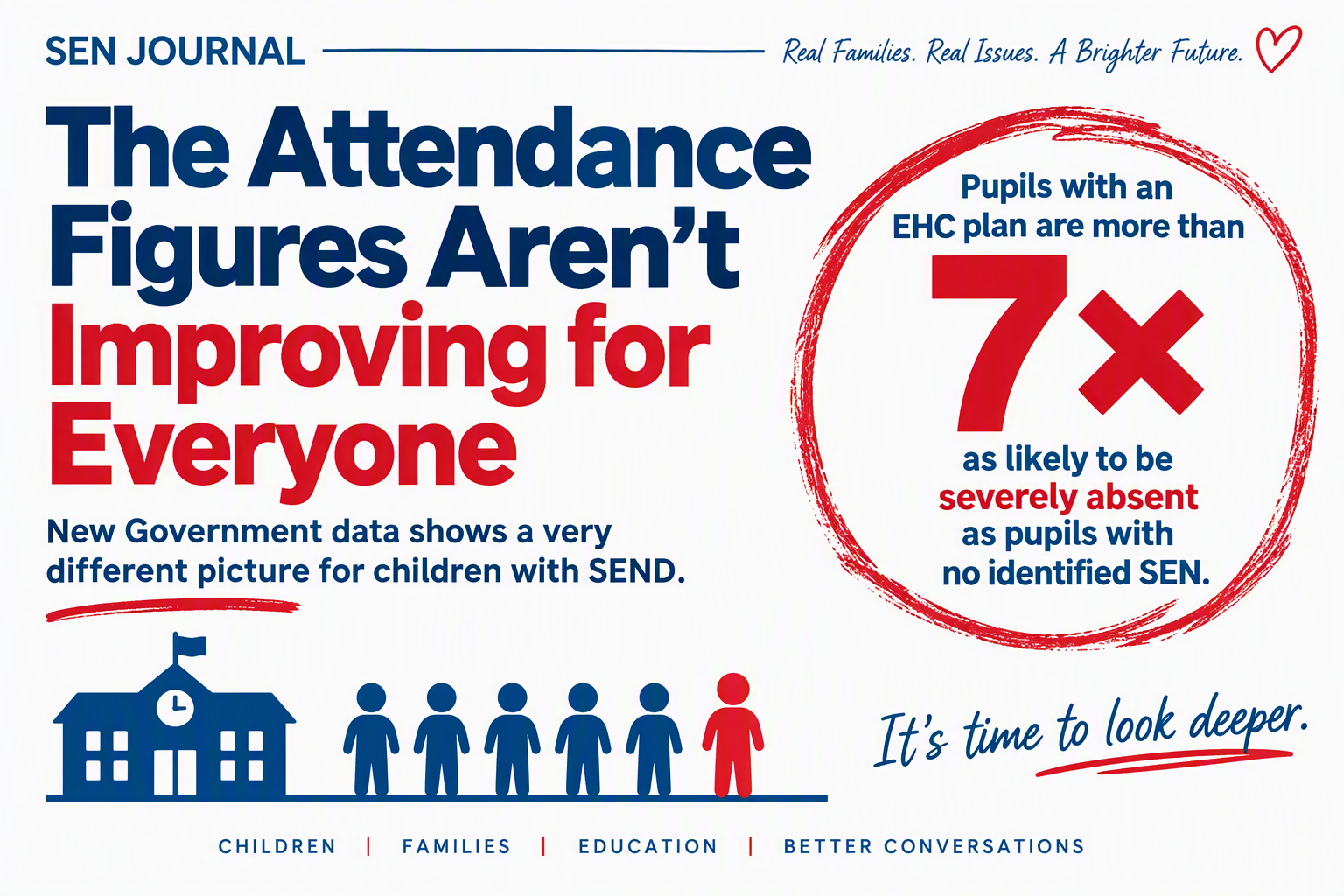
Pupils with an EHC plan are more than seven times as likely to be severely absent as pupils with no identified SEN.
Severe absence means missing 50% or more of possible school sessions.
That isn’t a small attendance problem is it? That represents children who are missing at least half of their available education.
And, for me, the question cannot simply be: “How do we improve their attendance?”
We need to be asking: Why are so many children with SEND struggling to access education in the first place?
The national headline doesn’t tell the whole story unfortunately!
Nationally, the figures show a small improvement. Overall absence reduced from 6.63% to 6.60%, and persistent absence reduced from 17.63% to 17.50%.
But once we start separating the figures by SEND status, something important happens. For pupils with an EHC plan, overall absence increased.
Persistent absence increased.
Severe absence increased.
Meanwhile, those measures decreased for pupils receiving SEN Support and for pupils with no identified SEN.
That distinction matters enormously.
Because we cannot say attendance is improving nationally and assume that improvement is being experienced equally by every child because it simply isn’t.
Then look at special schools
The special-school figures deserve attention too. Overall absence increased from 12.77% to 12.86%.
Severe absence increased from 6.66% to 6.88%. Persistent absence did fall, from 35.21% to 34.72%, but think about what that figure still represents:
More than one in three pupils in special schools were persistently absent.
Compare that with a national persistent absence figure of 17.50%. Something is happening here that deserves far more scrutiny than SEND simply appearing as another category in an attendance dataset.
But we need to be careful about what these figures prove
This matters. The statistics tell us what is happening.
They do not automatically tell us why it is happening.
They don’t prove that SEND itself causes absence.
They don’t prove that a school caused an individual child’s absence.
And they don’t tell us the circumstances of every child represented within those numbers. So I don’t think the responsible response is to take a national dataset and use it to make sweeping claims about every SEND pupil.
But equally, we cannot ignore the disparity. When children with EHC plans are more than seven times as likely to be severely absent as children with no identified SEN, that deserves investigation.
Not blame. Not assumptions. Investigation.
We need to start asking better questions
Too much of the national attendance conversation begins with: “Why isn’t this child attending school?”
For children with SEND, I think we urgently need to go further. Is the child able to access the environment?
Are their sensory needs understood? Are communication needs being met? Is anxiety creating a barrier to attendance?
Is the provision in their EHCP actually being delivered? Has their presentation changed? Has the placement ceased to be suitable?
Is the child receiving an education while they are unable to access school?
And, crucially: Are we recording the absence, or are we actually understanding it?
Those are not conclusions contained within the Government statistics. They are the questions the scale of the disparity should cause us to ask. Because an attendance percentage can tell us that a child wasn’t sitting in a classroom. It cannot tell us what happened before they stopped being able to get through the door.
SEND is not one group
There is another important part of this release that I for one am particularly interested in. The underlying Department for Education data can be broken down further by SEN primary need.
And that could be very revealing? In-fact why is that not revealed? Because SEND isn’t a diagnosis. It isn’t one experience and it certainly isn’t one homogeneous group of children.
An autistic child experiencing sensory overwhelm may face completely different barriers from a child with speech, language and communication needs, a child with physical needs, or a young person experiencing significant social, emotional or mental-health difficulties. So the next question I want us to explore isn’t simply:
“What is the SEND absence rate?”
It is:
Which children are disappearing from education, and what do their needs tell us?
Attendance policy must recognise the difference between unwilling and unable
For years, many SEND families have described children who desperately want an education but cannot consistently access the education currently available to them. That distinction matters.
Attendance intervention cannot become a substitute for identifying unmet need. Nor should an attendance percentage become the only measurement of whether a child is receiving a meaningful education.
Behind these statistics are individual children.
A child who may be overwhelmed.
A child whose needs may have changed.
A child whose placement may need reviewing.
A child who may be waiting for assessment or support.
A child who may desperately want to learn but currently cannot access the environment in which we expect that learning to happen.
And behind many of those children will be a family trying to hold everything together.
My takeaway
I don’t look at these figures and think: “We have an attendance problem.”
I look at them and think: We have an access-to-education question that urgently needs answering! Will the DfE answer? Probably not as it would derail the SEND Reform?
If pupils with EHC plans are more than seven times as likely to experience severe absence as children without identified SEN, the response cannot begin and end with getting those children through the school gates.
We need to understand what is happening before the absence.
What provision was in place?
What support was missing?
What changed?
What did the child communicate?
What did the family report?
What happened when concerns were first raised?
And what education was provided when attending school became difficult or impossible? That is where the conversation needs to go next. Because an attendance code records the absence.
It does not explain the child.
And if we genuinely want to improve attendance for children with SEND, understanding that child has to come first.
Andrea Dixon-Boldy
Founder, Advocate & Mentor – SEN Parent Support Group™
Source: Department for Education, Pupil absence in schools in England: autumn and spring term 2025/26, published 15 October 2026.
You may wish to view:
NEW DfE ATTENDANCE COMMUNICATION GUIDANCE – WHAT IT MEANS FOR PARENTS – SEN Parent Support Group
2027 – DfE Guidance for Schools on Inclusion and What Schools Should Do! – SEN Parent Support Group


For Support with attendance join our private FB group here
To become a member of our Resource Hub Plus click here

Understanding SEND
- EOTAS & AP: The real legal tests and current to SEND reform comparison
- LETTER: Post 16 SECTION 19 – Formal Letter to LA or Stage 1 Complaint
- GUIDANCE: SEND Need Descriptors For IEP via APDR
- QUICK GUIDE: Example SEND Graduated Response (How APDR is approached In Schools)
- RESOURCE: Executive Functioning
Communicating With School
- LETTER 4: To School following receipt of Formal Attendance Letter
- LETTER 3: To School Based on 3rd Attendance Letter Received
- LETTER 2: ATTENDANCE RESPONDING TO (BELOW 90% ATTENDANCE LETTER)
- LETTER 1: Responding to EARLY AWARENESS Letter from School (before 90% absence)
- LETTER: To School Requesting Reasonable Adjustment for Mobile Phone
Attendance, Exclusions & Sanctions
- Welsh Exclusions: What Happens, What You Can Ask For, and What Schools Must Do
- LETTER 1: Responding to EARLY AWARENESS Letter from School (before 90% absence)
- LETTER: Responding To Prosecution s444
- GUIDANCE: Exclusions Fixed Term or Permanent
- LETTER: To School When They Fail To Progress After Part Time Time-Table
Complaints
- LETTER: To LA – SEND Accountability Under S23 Children Act 2004
- LETTER: To LA When They Refuse to Reassess
- LETTER: Stage 1 LA on Grounds of Maladministration During EHCP NA Process
- LETTER: Post 16 SECTION 19 – Formal Letter to LA or Stage 1 Complaint
- LETTER: To School Requesting Reasonable Adjustment for Mobile Phone