What Parents Can Do When Sections B and F Are Not Lawful
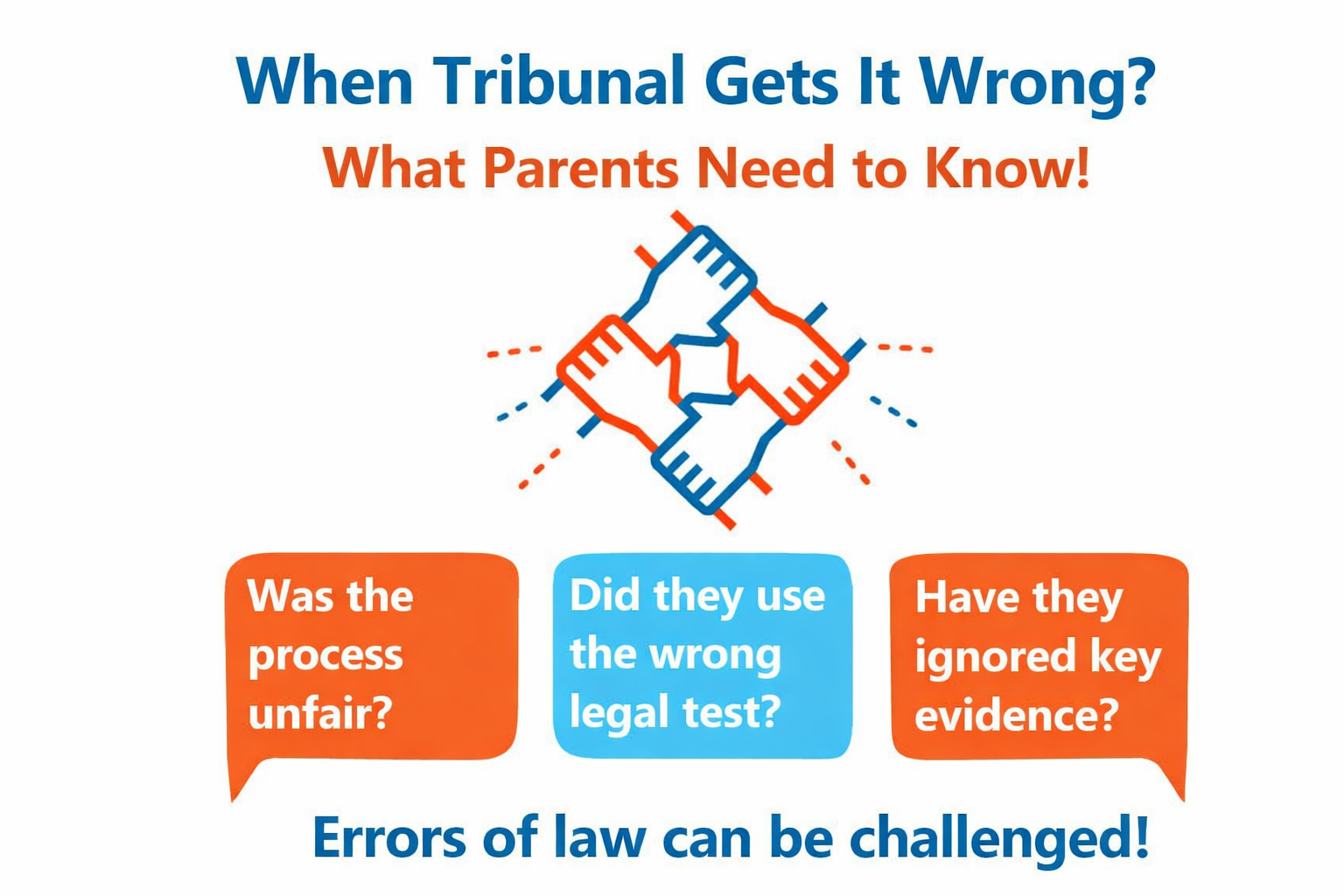
Most parents don’t realise this until they’re standing in the rubble of a Tribunal decision that simply doesn’t reflect their child: sometimes the First‑tier Tribunal gets it wrong. Not because parents didn’t present the evidence or because the child doesn’t have the needs. But because the judge has made a procedural error, ignored evidence, or produced a decision that doesn’t meet the legal test for Sections B and F.
Before we talk about appeals, Upper Tribunal, or rewriting the plan, we start with the first question every parent should ask:
Is this a situation where a “set‑aside” is appropriate?
A set‑aside (Rule 45) is only used when something went wrong with the process of the hearing itself. It is not about disagreeing with the judge’s conclusions. It is about whether the hearing was fair.
A set‑aside may be appropriate when:
• key evidence was not considered because of an administrative error
• the parent was prevented from presenting their case
• the LA failed to comply with directions and this prejudiced the outcome • the Tribunal made a procedural irregularity that affected fairness
• the decision was issued without considering documents that were properly filed
If the issue is procedural, a set‑aside can be the quickest way to correct the decision without escalating to the Upper Tribunal. Historically, set‑asides succeed when the error is clear, documented, and directly linked to the fairness of the hearing.
They do not succeed when the parent simply disagrees with the judge’s reasoning.
When the problem is not procedural but legal, the route is different.
Parents often ask: “What do I do when the judge has not made a lawful decision on Sections B and F?” This is where the process becomes more structured – and more powerful.
When a Tribunal decision is legally flawed, the next step is to request permission to appeal to the Upper Tribunal. This is not about re‑arguing the case. It is about showing that the First‑tier Tribunal made an error of law.
Errors of law include:
• missing needs in Section B
• misdescribed needs
• ignoring or misinterpreting expert evidence
• vague, unquantified, unenforceable provision in Section F
• provision that does not meet the statutory test (“must secure”)
• reasons that are inadequate or irrational
• applying the wrong legal test entirely
Historically, Upper Tribunal appeals succeed when the parent can clearly show:
• the judge ignored relevant evidence
• the judge preferred LA evidence without lawful justification
• the decision contradicts established case law
• the reasoning is so unclear that the parent cannot understand how the decision was reached
Parents do not need to prove the judge was “wrong”. They need to prove the judge was legally wrong.
So what must a parent do?
First, they must obtain the written reasons if they haven’t already. The clock for appeal starts from the date the written reasons are issued, not the oral decision. The timeline is 30 days from the Tribunal.
Next, they must identify the specific legal errors. This is where many parents panic, but the truth is simple: if Section B does not contain all needs, or Section F is vague, unquantified, or not linked to Section B, the decision is already on shaky legal ground.
Parents then submit a permission to appeal request to the First‑tier Tribunal. If permission is refused (and it often is), they apply directly to the Upper Tribunal. Many successful appeals begin with an initial refusal – it is not a sign of weakness in the case.
During this process, the LA is still required to implement the Tribunal’s decision unless the parent requests a pause. Some LAs will agree to pause amendments because they know the plan is likely to be overturned. Others will not. Parents should always notify the LA that the decision is being challenged and request that amendments are paused pending the appeal.
The most important message for parents is this: A flawed Tribunal decision is not the end of the road. It is the beginning of the next stage.
Parents who succeed in correcting unlawful decisions do three things consistently:
• they act quickly
• they focus on legal errors, not emotion
• they keep their evidence organised and linked to the statutory tests
And historically, when a Tribunal has failed to include needs or has allowed vague provision, the Upper Tribunal has been clear: the law must be followed. Needs must be described. Provision must be specific. Children are entitled to clarity, not guesswork.
And historically, when a Tribunal has failed to include needs or has allowed vague provision, the Upper Tribunal has been clear: the law must be followed. Needs must be described. Provision must be specific. Children are entitled to clarity, not guesswork.
Here is a checklist for you to work through to establish if a UTT is required. This checklist also includes a template to submit to Tribunal.
To join other parents struggling with navigating these challenges then please join us within our closed Facebook Group here


Understanding SEND
- EOTAS & AP: The real legal tests and current to SEND reform comparison
- LETTER: Post 16 SECTION 19 – Formal Letter to LA or Stage 1 Complaint
- GUIDANCE: SEND Need Descriptors For IEP via APDR
- QUICK GUIDE: Example SEND Graduated Response (How APDR is approached In Schools)
- RESOURCE: Executive Functioning
Communicating With School
- RESOURCE: When School Say “Your Child is FINE in School”
- LETTER 4: To School following receipt of Formal Attendance Letter
- LETTER 3: To School Based on 3rd Attendance Letter Received
- LETTER 2: ATTENDANCE RESPONDING TO (BELOW 90% ATTENDANCE LETTER)
- LETTER 1: Responding to EARLY AWARENESS Letter from School (before 90% absence)
Attendance, Exclusions & Sanctions
Complaints
- LETTER: To LA – SEND Accountability Under S23 Children Act 2004
- LETTER: To LA When They Refuse to Reassess
- LETTER: Stage 1 LA on Grounds of Maladministration During EHCP NA Process
- LETTER: Post 16 SECTION 19 – Formal Letter to LA or Stage 1 Complaint
- LETTER: To School Requesting Reasonable Adjustment for Mobile Phone