by SEN Parent Support Group™
The document in question 06/8/2026 : Release home – Pupil absence in schools in England – Explore education statistics – GOV.UK
Absence is rising again and the government’s own data makes one thing painfully clear: children with SEND are still being failed. Not because families don’t value education, not because parents aren’t “prioritising attendance”, but because the system designed to support their children simply isn’t functioning and hasn’t for a long time!
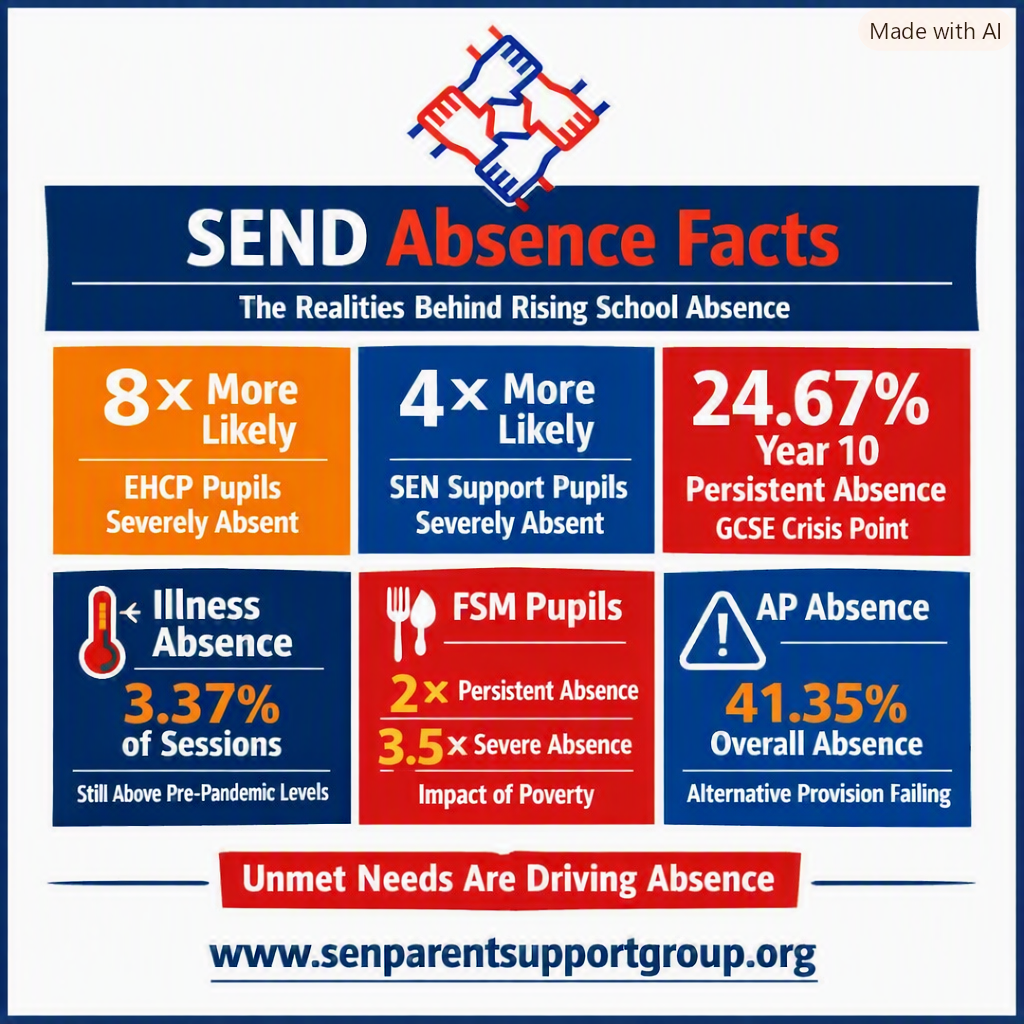
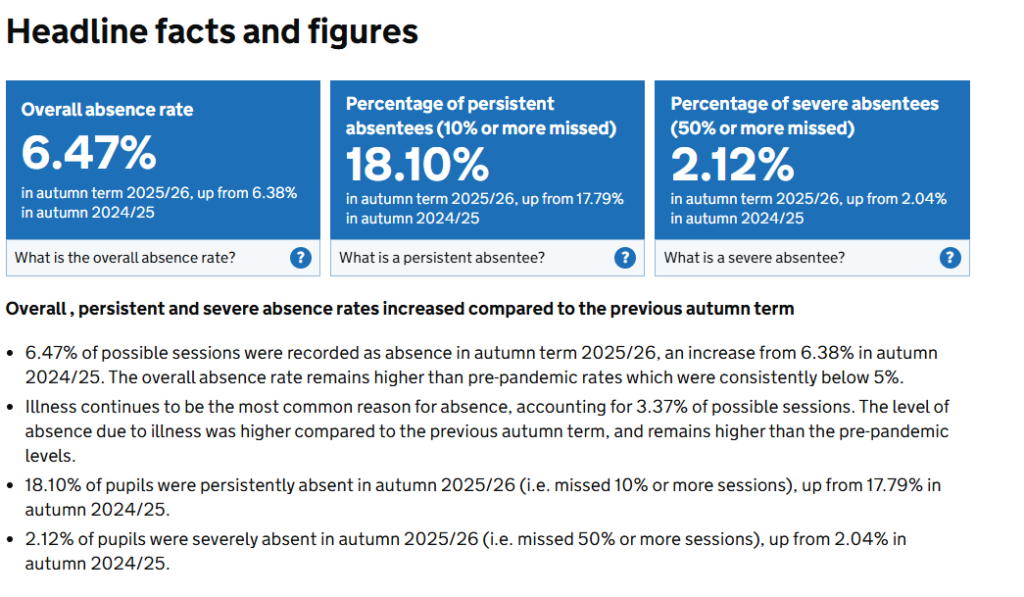
This autumn, overall absence rose to 6.47%. Persistent absence climbed to 18.10%, and severe absence increased again to 2.12%. These numbers matter, but the story underneath them matters more. Illness remains the biggest driver of absence, accounting for 3.37% of all possible sessions, still far above pre‑pandemic levels.(I despair comparing to Covid times – however the Gov seem to like using that benchmark!)
When a child with unmet needs is repeatedly ill, exhausted, anxious, or dysregulated, attendance becomes a symptom, not a behaviour. The data confirms what families have been saying for years.
For pupils with SEND, the picture is stark. Absence increased for children with EHCPs and those on SEN Support, while it decreased for pupils with no identified SEN. Persistent absence rose across every group, but children with SEND remain disproportionately affected. A child with an EHCP is almost eight times more likely to be severely absent than a child with no SEN. A child on SEN Support is almost four times more likely. These aren’t small gaps – they are evidence of systemic failure.
When a child is eight times more likely to be severely absent, it is not because their parents don’t care. It is because their needs are not being met in school. It is because provision is inconsistent, delayed, diluted, or missing entirely. It is because the environment is not accessible. It is because support is stretched beyond capacity. It is because families are fighting for basic adjustments that should have been in place years ago.
The crisis peaks in Years 10 and 11, where persistent absence reaches 24.67% and severe absence hits 4.13%. These are the years when pressure intensifies, mental health deteriorates, and the gap between need and provision becomes impossible to bridge. Families are told attendance is the priority, but attendance cannot be prioritised when the child’s wellbeing has already been compromised.
Alternative Provision, which should be a safety net, is in crisis. Absence in AP is now 41.35%. Persistent and severe absence continue to rise. When nearly half of all sessions in AP are missed, it is not a child problem it is a system problem. AP is meant to re‑engage children, not lose them.
Across regions, the pattern repeats. London has the lowest absence rates; the North East and Yorkshire & Humber have the highest. These aren’t cultural differences they are differences in deprivation, service availability, and the capacity of local systems to meet need.
The government’s own statistics tell a story that families have lived for years: absence is not about parental attitudes. It is about unmet need. It is about children who cannot access education safely, consistently, or meaningfully. It is about environments that are not designed for neurodivergent learners. It is about support that arrives too late, too inconsistently, or not at all.
If policymakers want to reduce absence, they must stop treating it as a behaviour to be managed and start treating it as a message to be understood. Attendance crackdowns, fines, and pressure do nothing to address the underlying causes. They simply punish the families already carrying the greatest load.
Children attend when they feel safe. They attend when their needs are met. They attend when the environment works for them. They attend when support is consistent, lawful, and properly funded.
Until the system delivers that, absence will continue to rise not because families don’t care, but because the system isn’t listening.
And yet, despite all of this, families continue to show extraordinary resilience. Every day, parents navigate systems that weren’t built for their children and still manage to keep going. Every day, children with SEND demonstrate courage, creativity, and determination in environments that often don’t understand them. The data may show rising absence, but it also shows something else: unmet need is visible now in a way it has never been before. We are no longer whispering about it it is written in the government’s own statistics.
That visibility is power.
It means the conversation can no longer be reduced to attendance slogans or punitive guidance. It means policymakers cannot ignore the structural realities families face. It means the truth is finally on record: children attend when their needs are met, and the responsibility for meeting those needs sits with the system, not the child.
Our community will keep pushing for lawful, meaningful, properly funded support. We will keep amplifying the voices of families who have been side lined for too long. And we will keep reminding the country that SEND children are not a problem to be managed they are young people with potential, rights, and futures worth investing in.
Absence tells us where the system is breaking. Advocacy tells us how we fix it. And together, we will keep moving towards a landscape where every child can access education safely, confidently, and without compromise.
Want to be a part of our community? Click here
Need resources to navigate this path at every stage? Click here
Read our many blogs below ⬇️
- 2027 – DfE Guidance for Schools on Inclusion and What Schools Should Do!
- Who’s Masking? A SEN Parent’s Guide to Identifying Masking, Responding Safely, and Evidencing What School Cannot See
- SEN Parent Support Group™ – Supporting Parents Through EHCPs, SEND Law, Neurodiversity and Advocacy
- Child Unable to Start Their New School or New Year?
- Understand how Early Help, CIN plans, reasonable adjustments, and EHCPNA all interact and why referrals are likely to increase under the new DfE absence and inclusion guidance.
See our resources below:

Understanding SEND
- EOTAS & AP: The real legal tests and current to SEND reform comparison
- LETTER: Post 16 SECTION 19 – Formal Letter to LA or Stage 1 Complaint
- GUIDANCE: SEND Need Descriptors For IEP via APDR
- QUICK GUIDE: Example SEND Graduated Response (How APDR is approached In Schools)
- RESOURCE: Executive Functioning
Communicating With School
- LETTER 4: To School following receipt of Formal Attendance Letter
- LETTER 3: To School Based on 3rd Attendance Letter Received
- LETTER 2: ATTENDANCE RESPONDING TO (BELOW 90% ATTENDANCE LETTER)
- LETTER 1: Responding to EARLY AWARENESS Letter from School (before 90% absence)
- LETTER: To School Requesting Reasonable Adjustment for Mobile Phone
All Things EHCP
Attendance, Exclusions & Sanctions
- Welsh Exclusions: What Happens, What You Can Ask For, and What Schools Must Do
- LETTER 1: Responding to EARLY AWARENESS Letter from School (before 90% absence)
- LETTER: Responding To Prosecution s444
- GUIDANCE: Exclusions Fixed Term or Permanent
- LETTER: To School When They Fail To Progress After Part Time Time-Table
Complaints
- LETTER: To LA – SEND Accountability Under S23 Children Act 2004
- LETTER: To LA When They Refuse to Reassess
- LETTER: Stage 1 LA on Grounds of Maladministration During EHCP NA Process
- LETTER: Post 16 SECTION 19 – Formal Letter to LA or Stage 1 Complaint
- LETTER: To School Requesting Reasonable Adjustment for Mobile Phone