A saveable guide to support your request for Section 19 – by SEN Parent Support Group™
Firstly, Join us here for full unprecedented support
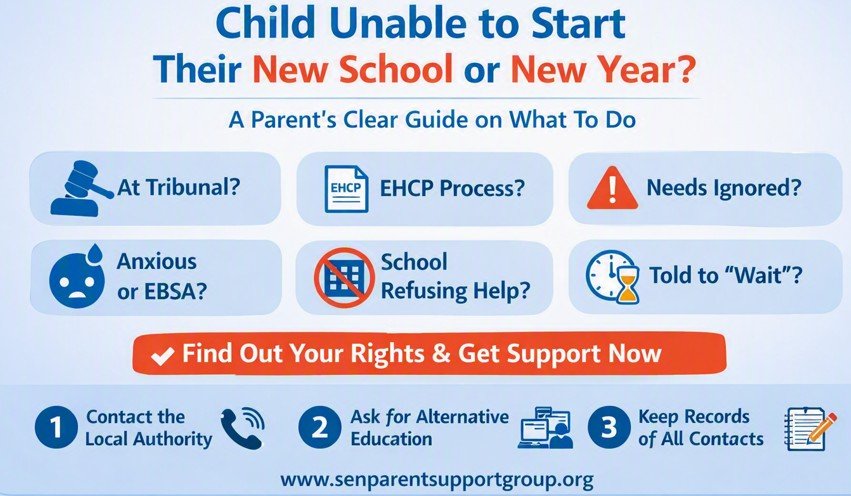
1. If you are at Tribunal appealing Section I (placement) Your child cannot be forced to start at the LA’s named school while the appeal is active. The LA has a non‑delegable duty under s.42 Children and Families Act 2014 to secure all provision in Section F even if the child is not attending.
If the child cannot attend the named school due to unmet needs, anxiety, EBSA, or unsafe placement, the LA must arrange alternative education under s.19 Education Act 1996. This applies even if the LA believes their placement is suitable the duty is triggered by lack of access, not by fault or blame. Read this Blog for more in depth knowledge on this subject whilst at Tribunal.
2. If you are in the EHCP Needs Assessment (EHCPNA) process The LA still has a legal duty to ensure your child receives education. If your child cannot attend school due to unmet needs, anxiety, SEN not being supported, or medical/mental health barriers, the LA must arrange s.19 education while the assessment is ongoing. Schools cannot refuse to support your child “because there is no EHCP yet”. The graduated approach and reasonable adjustments (APDR) under the Equality Act 2010 still apply. Read this to understand more about APDR
3. If SEN is not acknowledged by school A school cannot refuse to meet needs simply because they have not formally labelled them. If your child cannot attend due to unmet needs, anxiety, sensory overload, trauma, or lack of adjustments, the LA must step in. Once a child is not receiving suitable education, the LA’s s.19 duty activates regardless of whether SEN is formally recognised.
4. If your child is EBSA and unable to attend EBSA is a needs‑based barrier, not a behaviour issue. The LA must provide suitable education that meets the child’s age, ability, aptitude, and SEN. This can be:
• tutoring • online provision • hybrid packages • specialist outreach • interim placements • medical/sensory/anxiety‑informed provision
The duty is immediate – not after a meeting, not after a referral, not after a wait.
5. If the school says “wait until support is in place” This is unlawful. If a child cannot attend, the LA must arrange alternative provision now, not later. The school cannot mark absence as unauthorised when the barrier is unmet need.
6. If the LA says “we can’t do anything until…” The law does not allow the LA to delay education because:
• you’re waiting for EHCPNA • you’re waiting for a draft • you’re waiting for a placement • you’re appealing • you’re waiting for CAMHS • you’re waiting for a school to “get ready”
The duty to provide education is continuous and non‑delegable.
Key message for parents today: If your child cannot attend school due to unmet needs, anxiety, disability, or unsafe placement the LA must provide suitable education. You do not need to prove fault. You do not need to wait for a plan. You do not need to wait for Tribunal. You do not need to wait for a meeting. The duty exists because your child is not accessing education, full stop.
Law and case law detailed below for you to quote:
1. When appealing Section I (placement)
- Children and Families Act 2014 s.42(2) the LA “must secure the specified special educational provision for the child.”
- Education Act 1996 s.19(1) duty to arrange suitable education for children “who, by reason of illness, exclusion or otherwise, may not receive suitable education.”
- Case law:
- L v Clarke & Somerset CC [1998] ELR 129 confirms the LA’s duty continues even when a child is out of school.
- NA v London Borough of Barnet [2010] UKUT 180 (AAC) Tribunal appeal does not suspend the s.42 duty.
- EH v London Borough of Hackney [2011] UKUT 315 (AAC) LA must provide education pending appeal.
2. During an EHCP Needs Assessment (EHCPNA)
- Education Act 1996 s.19 again applies if the child cannot attend.
- SEND Regulations 2014 reg. 6–10 set timescales for assessment; no lawful “pause” in education.
- Equality Act 2010 s.20 duty to make reasonable adjustments.
- Case law:
- R v London Borough of Croydon [2015] EWHC 2263 (Admin) LA must act promptly to secure interim provision.
- R (B) v Cambridgeshire CC [2016] EWHC 1628 (Admin) confirms s.19 applies during EHCPNA.
3. When SEN is not acknowledged by school
- Children and Families Act 2014 s.22 schools must identify children with SEN.
- Equality Act 2010 s.85(6) prohibits discrimination in provision of education.
- Education Act 1996 s.19 triggers once a child is without suitable education.
- Case law:
- R v Sunderland City Council [2007] EWHC 1368 (Admin) LA duty arises even without formal diagnosis.
- R (G) v West Sussex CC [2021] EWHC 348 (Admin) failure to act on known needs breaches s.19.
4. Emotionally Based School Avoidance (EBSA)
- Education Act 1996 s.19 applies to anxiety‑based non‑attendance.
- Children and Families Act 2014 s.42 provision must be delivered even if not in school.
- Case law:
- R (B) v Cambridgeshire CC [2016] anxiety and mental‑health barriers trigger s.19.
- R v East Sussex CC [2006] EWHC 2362 (Admin) LA must provide education tailored to medical and emotional needs.
5. When school or LA says “wait until support is in place”
- Education Act 1996 s.19 duty is immediate.
- Children and Families Act 2014 s.42 non‑delegable; cannot be delayed.
- Case law:
- R v Nottinghamshire CC [2000] ELR 189 unlawful to delay provision pending placement.
- Buckinghamshire CC v SEN Tribunal [1997] ELR 81 confirms continuous
For letters to request APDR, commence / enforce s19 or address the LA’s lack of action then please see our resources below within the grid. We have over 450 – visual, timelines, letters, quick guides and guidance to support these – as well as over 85 SEND Blogs within our SEN Journal here
Do they work – hell yes they do – read our 5 🌟reviews here


Understanding SEND
- EOTAS & AP: The real legal tests and current to SEND reform comparison
- LETTER: Post 16 SECTION 19 – Formal Letter to LA or Stage 1 Complaint
- GUIDANCE: SEND Need Descriptors For IEP via APDR
- QUICK GUIDE: Example SEND Graduated Response (How APDR is approached In Schools)
- RESOURCE: Executive Functioning
Communicating With School
- LETTER 4: To School following receipt of Formal Attendance Letter
- LETTER 3: To School Based on 3rd Attendance Letter Received
- LETTER 2: ATTENDANCE RESPONDING TO (BELOW 90% ATTENDANCE LETTER)
- LETTER 1: Responding to EARLY AWARENESS Letter from School (before 90% absence)
- LETTER: To School Requesting Reasonable Adjustment for Mobile Phone
Attendance, Exclusions & Sanctions
- Welsh Exclusions: What Happens, What You Can Ask For, and What Schools Must Do
- LETTER 1: Responding to EARLY AWARENESS Letter from School (before 90% absence)
- LETTER: Responding To Prosecution s444
- GUIDANCE: Exclusions Fixed Term or Permanent
- LETTER: To School When They Fail To Progress After Part Time Time-Table
Complaints
- LETTER: To LA – SEND Accountability Under S23 Children Act 2004
- LETTER: To LA When They Refuse to Reassess
- LETTER: Stage 1 LA on Grounds of Maladministration During EHCP NA Process
- LETTER: Post 16 SECTION 19 – Formal Letter to LA or Stage 1 Complaint
- LETTER: To School Requesting Reasonable Adjustment for Mobile Phone